Carnival Game Rentals: 15 Booth Games and What They Cost for School and Church Festivals
You're planning a school carnival or church festival, and you know booth games are the backbone of the whole event. But when you start calling around for quotes, the pricing feels all over the map—and you're not sure what's reasonable or what you actually need.
This guide breaks down 15 of the most popular carnival game rentals, what each one costs, how much space they need, and which age groups they work best for. You'll walk away knowing exactly what to budget and how to build a booth lineup that keeps lines moving and kids smiling.
What's Inside This Guide
- →Which Type of Festival Organizer Are You?
- →How Much Does It Cost to Rent Carnival Games?
- →15 Carnival Booth Games: What They Cost and How They Work
- →What Pushes Carnival Game Rental Costs Up or Down
- →How Many Games Do You Actually Need?
- →Package Deals vs. A La Carte Rentals
- →Do Rentals Include Prizes and Supplies?
- →Frequently Asked Questions
Which Type of Festival Organizer Are You?
First-Time PTO Carnival Chair
You volunteered because no one else would, and now you're staring at a blank spreadsheet wondering what "carnival booth" even means. You need a simple package deal with 8-12 age-appropriate games that don't require complicated setup or constant supervision.
Budget sweet spot: $900-$1,200 total for a 4-hour elementary school event.
Experienced Church Festival Coordinator
You've done this before. You know ring toss is a crowd favorite and the dart games always run out of balloons. You're looking for specific booth games to fill gaps in what your volunteers are already handling—maybe 4-6 rental additions to round out your lineup.
Budget sweet spot: $400-$700 for targeted a la carte rentals.
Large-Scale Community Event Planner
You're planning a 500+ attendee festival with multiple zones, food trucks, and entertainment stages. You need 15-20 booth games that span preschool through middle school age ranges, plus enough variety that kids want to play multiple booths.
Budget sweet spot: $1,800-$2,800 for comprehensive game coverage.
How Much Does It Cost to Rent Carnival Games for a School Festival?
The short answer: individual carnival game rentals run $75 to $250 per booth for a standard 4-6 hour event. Package deals that include 8-12 games typically land between $800 and $1,500, depending on the mix of games and whether setup and breakdown are included.
Here's how pricing generally breaks down:
💡 Pro Tip: Package deals average out to $100-$125 per game, which is 15-25% less than a la carte pricing. If you need 6+ games, ask about festival packages before pricing individual booths.
15 Carnival Booth Games: What They Cost and How They Work
Here's a detailed breakdown of the most popular carnival game rentals for school and church festivals. Each listing includes typical rental cost, space requirements, recommended age range, and what makes it work well (or not) for different event types.
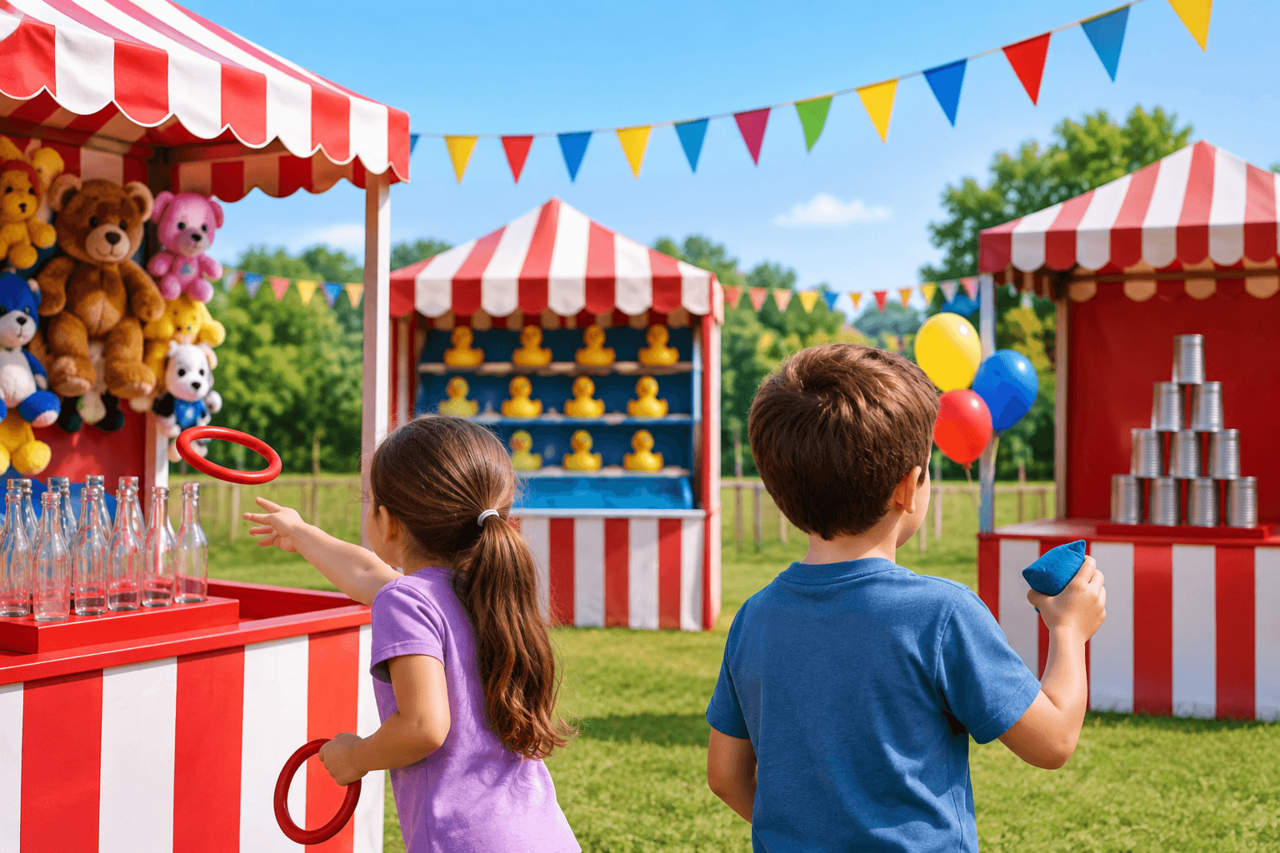
1. Ring Toss (Bottle or Peg Variation)
$75–$100How it works: Players toss rings onto bottles or pegs from 4-8 feet away. Land a ring, win a prize.
Space needed: 6x6 feet
Best for ages: 5-12
Why it works: Simple setup, fast rounds, universally understood. Kids love the clink sound when they land a ring.
2. Bean Bag Toss / Cornhole
$80–$110How it works: Toss bean bags through holes in a slanted board. Different point values based on hole size or board zones.
Space needed: 8x10 feet
Best for ages: 6-14
Why it works: Everyone already knows how to play. Works indoors or outdoors. Themed boards (school mascot, holiday designs) add personality.
3. Duck Pond
$125–$150How it works: Floating rubber ducks with numbers on the bottom spin in a small pool. Pick a duck, match the number to a prize tier.
Space needed: 6x8 feet
Best for ages: 3-8
Why it works: No skill required—every kid wins something. Perfect for preschool and kindergarten crowds. Keeps lines moving fast.
4. Fishing Game
$130–$160How it works: Kids use magnetic fishing rods to catch magnetic fish in a small pool or fabric pond. Each fish has a number that corresponds to a prize.
Space needed: 6x8 feet
Best for ages: 3-7
Why it works: Another everyone-wins game that's perfect for little kids. The "fishing" element is engaging and doesn't require coordination.
5. Milk Bottle Knockdown
$125–$150How it works: Stack of weighted bottles (usually 6-10 stacked in a pyramid). Players throw softballs to knock down as many as possible.
Space needed: 8x10 feet
Best for ages: 7-14
Why it works: Satisfying crash when bottles fall. You can adjust difficulty by spacing the pyramid tighter or looser. Loud, visual, competitive—older kids love it.
6. Basketball Toss
$140–$170How it works: Mini basketball hoops (usually 2-3 side by side). Players shoot foam or rubber balls. Make 2 out of 3 shots to win.
Space needed: 8x10 feet
Best for ages: 6-14
Why it works: Competitive and repeatable. Kids will come back to try again if they miss. Plays well for both elementary and middle school ages.
7. Tic-Tac-Toe
$85–$115How it works: Giant tic-tac-toe board (usually 4x4 feet). Players toss bean bags to land three in a row.
Space needed: 6x8 feet
Best for ages: 5-10
Why it works: Familiar game mechanic. Doesn't take athletic skill—just aim. Works great indoors.
8. Balloon Dart Throw
$175–$225How it works: Wall or board covered with inflated balloons. Players throw darts to pop balloons. Each balloon has a prize slip inside or a color-coded prize tier.
Space needed: 8x10 feet
Best for ages: 10+
Why it works: Dramatic pop. Instant feedback. Higher cost because you're constantly replacing balloons—expect to budget $30-$50 extra for balloon refills during a 4-hour event.
⚠️ Caution: Balloon dart games require constant supervision and carry sharp-object liability. Many church and school festivals skip this one in favor of safer alternatives like ring toss or basketball.
9. Spin the Wheel
$150–$200How it works: Large prize wheel with pegs and sections marked with different prize tiers or point values. Player spins and wins whatever the wheel lands on.
Space needed: 6x6 feet
Best for ages: All ages
Why it works: Pure chance—everyone's excited. Works great as a "ticket redemption" booth where kids cash in tickets from other games. Zero skill required.
10. Cake Walk
$100–$150How it works: Circle of numbered squares on the floor. Music plays, players walk around the circle. When music stops, a number is drawn—if you're standing on that number, you win a cake (or cupcake, cookie, etc.).
Space needed: 12x12 feet (larger group activity)
Best for ages: All ages
Why it works: Social and low-pressure. Great for families to play together. You'll need donated baked goods, so coordinate with your volunteer committee.
11. Plinko
$180–$230How it works: Large vertical board with pegs arranged in a grid. Drop a disk from the top and watch it bounce randomly to the bottom. Prize slots at the bottom determine what you win.
Space needed: 6x8 feet
Best for ages: 6-14
Why it works: Pure suspense—everyone gathers to watch the disk drop. No skill, all anticipation. Kids line up to try it multiple times.
12. Skee-Ball Style Roll
$200–$250How it works: Slanted ramp with target holes at the top. Roll balls up the ramp to land in high-point zones.
Space needed: 10x12 feet (long footprint)
Best for ages: 8-14
Why it works: Classic arcade feel. Older kids and parents love it because it feels like real carnival skill. Rental units are heavier and more complex, which drives up cost.
13. Lollipop Pull
$90–$120How it works: Styrofoam board with holes holding lollipops. Each lollipop stick has a colored tip that corresponds to a prize tier. Pull a lollipop, check the color, claim your prize.
Space needed: 4x6 feet
Best for ages: 3-7
Why it works: Everyone wins a lollipop plus a prize. Super simple. Great for toddler and preschool sections.
14. Water Gun Race
$150–$200How it works: Players aim water guns at targets (usually moving horses or clowns on a track). First to fill their target container or cross the finish line wins.
Space needed: 8x10 feet + water access
Best for ages: 6-12
Why it works: Competitive head-to-head action. Feels like a midway game. Outdoor only unless you have serious floor drainage.
15. Ladder Toss (Bolo Toss)
$95–$130How it works: Three-rung ladder frame. Players toss bolo balls (two balls connected by a rope) to wrap around the rungs. Different rungs = different point values.
Space needed: 8x10 feet
Best for ages: 8-14
Why it works: Challenging enough to feel like an accomplishment when you land it. Popular at tailgates and backyard parties, so parents recognize it instantly.
What Pushes Carnival Game Rental Costs Up or Down
Not all carnival booth games cost the same, even when they look similar. Here's what actually drives pricing:
↑ What Pushes Cost Up
- Mechanical or moving parts — anything that spins, lights up, or requires assembly
- Consumable supplies — balloon dart games that burn through balloons during the event
- Large footprint — skee-ball and water races take more truck space and labor to move
- Delivery and setup included — full-service rentals cost 20-30% more than pickup options
- Saturday bookings — weekend prime time often carries a 10-15% premium over weekday rates
↓ What Keeps Cost Down
- Simple toss mechanics — ring toss, bean bag, tic-tac-toe require minimal setup
- Package bundles — renting 8-12 games together averages 15-20% savings per booth
- Weekday or Sunday events — less demand = better availability and sometimes lower pricing
- You pick up and return — self-service pickup can save $50-$150 in delivery fees
- Nonprofit or school discounts — many rental companies offer 10-15% off for PTOs and churches
How Many Carnival Games Do You Need for a School or Church Festival?
The rule of thumb: one game booth per 25-30 expected attendees at peak time. Not total attendance—concurrent peak attendance.
If your school carnival runs 3-4 hours and expects 300 total guests, your peak time might see 150 people on site at once. That means you'd want 5-6 game booths minimum, with 8-10 being ideal to avoid long waits.
Quick Sizing Guide by Event Type
Small Elementary Carnival
100-200 total guests
Recommended: 6-8 game booths
Mix: 2 no-skill (duck pond, fishing), 4 easy skill (ring toss, bean bag), 2 challenge games (basketball, milk bottles)
Mid-Size Church Festival
250-400 total guests
Recommended: 10-12 game booths
Mix: 3 no-skill, 5 easy skill, 3 challenge, 1 spin-the-wheel prize redemption
Large Community Event
500+ total guests
Recommended: 15-20 game booths
Mix: Zone by age (preschool area, elementary zone, tween section) with duplicate popular games to reduce wait times
💡 Pro Tip: Organize your booth layout strategically. Put high-demand games (duck pond, basketball) at opposite ends of the space to spread foot traffic. Place no-skill games near the entrance so younger kids can start playing immediately.
Package Deals vs. A La Carte Carnival Game Rentals
Most rental companies offer both bundled festival packages and individual booth rentals. Here's when each option makes sense:
Festival Package Bundles
Best for: First-time organizers, schools planning their only carnival of the year, churches hosting annual festivals
What you get:
- 8-12 pre-selected games
- Balanced mix of age ranges and difficulty levels
- Delivery, setup, and breakdown usually included
- One invoice, one point of contact
Typical package cost: $900-$1,500 (works out to $100-$125 per game)
A La Carte Individual Rentals
Best for: Experienced coordinators who know exactly what they need, organizations supplementing volunteer-run booths, events with specific themes
What you get:
- Total control over which games you rent
- Flexibility to add or remove booths
- Option to self-pickup and save on delivery
- Mix rental games with DIY volunteer booths
Typical per-game cost: $75-$250 depending on complexity
If you're planning your first big festival and need the entire booth lineup delivered, a package deal saves you 15-20% and eliminates decision fatigue. If you've done this before and just need to fill a few gaps, a la carte lets you cherry-pick exactly what you're missing.
Do Carnival Game Rentals Include Prizes and Supplies?
Short answer: Game equipment is included. Prizes are almost always separate.
When you rent a carnival game booth, you get:
- The game structure itself (booth frame, backdrop, playing surface)
- Game pieces (rings, bean bags, balls, fishing rods, ducks, etc.)
- Basic setup instructions (or full setup if you paid for delivery service)
- Signage (game rules, sometimes generic "Step Right Up" banners)
You are responsible for:
- Prizes (budget $50-$150 per booth depending on attendance)
- Booth volunteers to operate the games and hand out prizes
- Tickets or tokens if you're using a ticket system instead of direct prizes
- Extension cords and power for any games with lights or moving parts
💰 Prize Budget Rule of Thumb: Allocate $75-$100 per booth for prizes if you're expecting 100-200 kids. Bulk toy suppliers (Oriental Trading, Amazon Wholesale) offer carnival prize assortments for $30-$60 that cover 50-100 small prizes per pack.
Some rental companies do offer prize packages as an add-on—usually $50-$100 extra per booth. These typically include generic toys, stickers, and candy assortments. If you want prizes that match your school mascot or event theme, you'll need to source those separately.

How Carnival Games Fit Into Your Larger Festival Plan
Booth games are the backbone of most school and church carnivals, but they work best when paired with other attractions that keep families on site longer. If you're planning a larger event, this guide to large event planning services walks through how to coordinate rentals across categories—games, inflatables, food, and entertainment.
Many festivals also add one or two carnival rides as anchor attractions. Rides like mini Ferris wheels or swing rides draw crowds but require more space, higher budgets, and operator supervision. Games fill the gaps between ride lines and give kids something to do while waiting.
If your event skews toward elementary-age kids, adding a few combo bounce houses creates an activity zone separate from the booth game area. Older kids and parents gravitate toward games; younger kids burn energy in inflatables. Zoning your event by age group reduces crowding and improves flow.
💡 Pro Tip: Start planning your spring festival lineup in the winter. Most rental companies book up 6-8 weeks ahead for peak season (April-June). This guide to starting spring event planning early explains exactly when to book what.
Frequently Asked Questions About Carnival Game Rentals
How much does it cost to rent carnival games for a school festival? +
Individual carnival game rentals typically range from $75 to $250 per game for a 4-6 hour event. Classic booth games like ring toss or bean bag toss run $75-$125, while more interactive games like the duck pond or milk bottle knockdown cost $125-$175. Package deals for 8-12 games usually fall between $800 and $1,500, which breaks down to $100-$125 per game when bundled.
What carnival games are best for elementary school age kids? +
Duck pond, ring toss, bean bag toss, and fishing games work best for elementary-age children. These games have simple rules, quick rounds, and high success rates. They're also self-explanatory, which means less volunteer training and faster line movement during busy festival hours. For kids in grades 3-5, add challenge games like basketball toss or milk bottle knockdown to give older students something more competitive.
Do carnival game rentals include prizes and supplies? +
Most carnival game rentals include all game equipment and setup, but prizes are typically separate. Game pieces like rings, bean bags, and fishing poles are included. You'll need to budget $50-$150 per game booth for prizes depending on attendance. Some rental companies offer prize packages as an add-on ($50-$100 per booth), but if you want themed or custom prizes, you'll source those yourself from bulk suppliers.
How many carnival games do I need for a church or school festival? +
Plan for one game booth per 25-30 expected attendees at peak time. For a festival expecting 200 people throughout the day, your peak crowd might be 100-120 people—so 6-8 game booths will keep lines moving. Larger events with 400+ guests work best with 12-15 games spread across different difficulty levels and age appropriateness. Always think in terms of concurrent attendance, not total headcount.
Can you rent carnival games for indoor church events? +
Yes, most carnival booth games work perfectly indoors in fellowship halls or gymnasiums. Games like ring toss, duck pond, bean bag toss, and fishing games require minimal space (typically 6x6 feet per booth) and have no outdoor-only requirements. Just confirm your ceiling height for any games with vertical throws (basketball toss, bean bag high-arc games). Water-based games like water gun races need outdoor space or serious floor drainage.
What's the difference between carnival games and carnival rides? +
Carnival games are booth-style activities where participants compete for prizes—think ring toss, dart games, or duck ponds. Carnival rides are mechanical attractions like Ferris wheels or swings that provide entertainment through motion. Games require attendants and prizes; rides require operators and safety inspections. Games average $75-$250 per booth; rides start around $500+ per attraction. Most festivals mix both—games provide ongoing activity, rides serve as anchor attractions.
Ready to Book Your Carnival Game Rentals?
Whether you need a full festival package or just a few booth games to round out your volunteer lineup, ChrisAlly makes it simple. Browse our game rentals, check real-time availability, and lock in your date—no pressure, no pitch, just honest pricing and reliable delivery.
Book Your Party Today!Questions about which games work best for your event? Call 678-752-8718 and we'll walk you through it.